GA, UNITED STATES, November 13, 2026 /EINPresswire.com/ — Artificial intelligence for materials science is moving beyond isolated prediction and optimization toward integrated research systems that connect computation, experimentation and scientific reasoning. Yet materials are multiscale and path-dependent, and experimental observations remain incomplete, making it difficult to preserve scientific continuity across material evolution, evidence and interpretation. This review proposes materials world models (MWMs) as physically grounded, evidence-aware research frameworks that maintain a persistent representation of material states, histories, observations and interpretations. The authors define four minimum operational requirements and five capabilities for scientific continuity, and argue that two mutually reinforcing foundations—a soft foundation of AI algorithms and multiscale computation, and a hard foundation of AI-enabled laboratories and robotics—together form the data source on which future scientific discovery depends.
The Materials Genome Initiative (MGI), launched in the United States in 2011, aimed to accelerate the discovery, development, manufacturing, and deployment of advanced materials by at least a factor of two while substantially reducing costs. More than a decade on, materials behavior remains hard to capture: processing changes phase stability, defect populations and microstructure, so identical nominal compositions can reach different physical states, while measurements are indirect, heterogeneous and shaped by sampling, calibration and specimen preparation. Property prediction does not establish how a candidate can be physically realized, laboratory automation does not necessarily preserve a persistent material representation, and agents may coordinate tools without linking outputs to specimens and processing histories. Based on these challenges, in-depth research on materials world models that connect material evolution, experimental evidence and revisable scientific interpretation is urgently needed.
Professor Tong-Yi Zhang, Dr. Jie Xiong from the Materials Genome Institute and the State Key Laboratory of Materials for Advanced Nuclear Energy at Shanghai University, together with Professor Yongchang Liu from the State Key Laboratory of High Performance Roll Materials and Composite Forming at Tianjin University, published (DOI: 10.1016/j.orig.2026.11.001) the review in Originality on 1 November 2026. The corresponding author, Academician Tong-Yi Zhang of Shanghai University, is a leading advocate of materials genome engineering and materials informatics in China. The paper traces how the MGI is being extended under artificial intelligence (AI) acceleration toward materials world models (MWMs), and sets out the soft and hard foundations that connect computational prediction with physical experimentation.
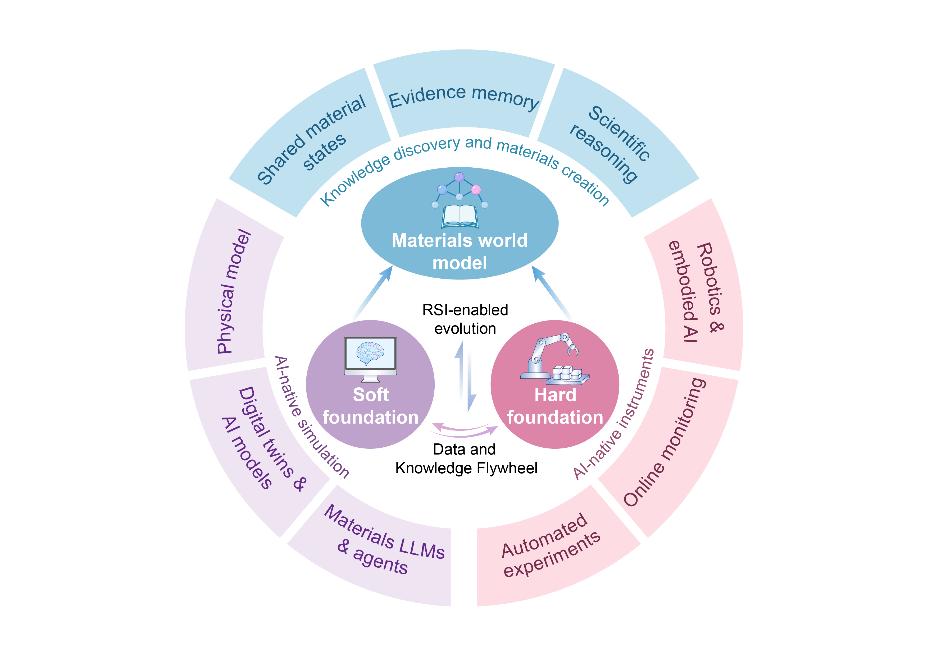
The review identifies five characteristics that make materials research unusually demanding: multiscale coupling, path-dependent evolution, partial observation, constrained physical actions and revisable composition–processing–structure–properties (CPSP) relationships. An MWM must maintain identifiable material states and processing histories, link observations and predictions to physical conditions and supporting evidence, let new observations update states and, where justified, revise competing interpretations, and feed those updates into later predictions and actions. The authors define five capabilities for scientific continuity: evidence traceability, feedback-driven adaptation, research workflow orchestration, scientific interpretation revision and conditional knowledge reuse. The framework rests on two foundations. The soft foundation combines physical models, digital twins, materials knowledge and scientific agents for prediction and reasoning; the hard foundation combines automated laboratories, intelligent instruments and embodied intelligence for physical experimentation. Shared material records and evidence memory connect them into a data and knowledge flywheel, in which recursive self-improvement (RSI) refines research procedures while physical validation remains essential. Crucially, the two foundations are not separate tools but two halves of one data source: high-fidelity simulation and multiscale computation on one side, AI experiment robots and AI laboratories on the other, continuously feeding each other.
The authors said the central shift is from predicting properties to sustaining a scientific relationship with a material over time. They said the soft foundation of AI algorithms and multiscale computation and the hard foundation of AI experiment robots and AI laboratories together constitute the source of data, with data flowing continuously between the two systems, and that high-precision simulation sits at the core of a world model. They added that AI remains a powerful assistant, not a replacement for human intuition, and that human–machine collaboration is the mainstream model.
The authors propose near-term demonstrations on well-characterized problems such as alloy aging, phase transformations, battery degradation and catalytic surface evolution, followed by tighter integration between scientific agents and AI-native instruments. The longer-term goal is knowledge development across successive research campaigns, including transfer of validated findings to new compositions and processing conditions. Nuclear structural alloys are highlighted as a representative case, where irradiation damage, thermal aging and mechanical degradation involve coupled mechanisms and extended histories; similar challenges arise in battery electrodes, semiconductor devices and catalysts. Evaluation must move beyond predictive benchmarks to campaign-level tests of state reconstruction, mechanism discrimination, experimental decision-making, evidence memory and cross-campaign learning. Building such systems requires coordinated teams in engineering, digital twins and mechatronics, working with industry on joint research.
DOI
10.1016/j.orig.2026.11.001
Original Source URL
https://doi.org/10.1016/j.orig.2026.11.001
Lucy Wang
BioDesign Research
email us here
Legal Disclaimer:
EIN Presswire provides this news content “as is” without warranty of any kind. We do not accept any responsibility or liability
for the accuracy, content, images, videos, licenses, completeness, legality, or reliability of the information contained in this
article. If you have any complaints or copyright issues related to this article, kindly contact the author above.

Media gallery