Vadzo Imaging breaks down Legal Frame Mode HDR and explains how sensor-level LFM technology eliminates headlight flare in intelligent transportation system cameras deployed at intersections, tolling lanes, and highway surveillance nodes.
FORT WORTH, TX / ACCESS Newswire / June 1, 2026 / Vadzo Imaging, a provider of embedded vision imaging solutions, is addressing one of the most persistent image quality challenges in intelligent transportation deployments: the progressive loss of vehicle and license plate detail caused by headlight flare. Across tolling infrastructure, intersection monitoring nodes, and highway surveillance corridors, high-dynamic-range imaging is no longer a specification item. It is the functional threshold below which an ITS camera cannot be considered production-ready.
The underlying problem is not simply brightness. Vehicle headlights in a night scene can exceed ambient scene luminance by several orders of magnitude, pushing the pixel wells of a standard image sensor into saturation and blooming across adjacent pixels. The result is a washed-out zone around each headlight source that obliterates the license plate, front axle geometry, and vehicle classification data that automated enforcement and tolling systems depend on. A traffic surveillance camera that cannot resolve this challenge will generate detection gaps in exactly the conditions where data integrity matters most: nighttime, high-density vehicle flows, and multi-lane intersections with mixed oncoming and cross traffic.
The answer Vadzo brings to embedded vision engineers and OEM developers is Legal Frame Mode HDR. This press release explains what Legal Frame Mode is, how it differs from other HDR exposure methods, and why sensor-level implementation is the correct architectural choice for any HDR ITS camera intended for roadside deployment.
What Standard HDR Exposure Methods Cannot Solve
Most high dynamic range camera implementations in surveillance use multi-exposure HDR, which combines a long and a short exposure frame captured sequentially or in an interleaved pattern. The long exposure recovers shadow and mid-tone detail. The short exposure retains highlight data. These two frames are merged by the ISP into a single HDR output.
Multi-exposure HDR works well in static scenes. In a traffic monitoring camera context, the scene is never static. A vehicle travelling at 80 km/h moves approximately 22 metres per second. The positional offset between the long and short exposure frames at standard frame rates is large enough to produce misalignment artefacts at vehicle edges and particularly at license plates. These motion artefacts are not cosmetic. They degrade the OCR confidence of automated number plate recognition systems and introduce rejection errors in tolling pipelines.
Digital overlap, HDR, and frame-averaged techniques share the same fundamental limitations. They all capture scene luminance across multiple moments in time and then merge the results. Any object with velocity relative to the sensor introduces ghost artefacts into the merged output. For an intersection monitoring camera capturing continuous streams of moving vehicles, the problem is endemic, not occasional.
Legal Frame Mode HDR: How It Works
Legal Frame Mode (LFM) is a sensor-level HDR architecture in which the complete HDR exposure is captured within a single frame period. There is no time offset between the shadow-detail capture and the highlight-detail capture. The legal frame mode camera sensor captures HDR data within the same frame period using sensor-level multi-gain or interleaved HDR techniques, then the ISP merges them into a single high-dynamic-range output frame that represents a single instant in time.
The significance of ITS camera deployments is structural. Because the long-exposure and short-exposure data share the same timestamp, there is no inter-frame motion to produce misalignment. A vehicle moving at highway speed, with headlights that would saturate a conventional sensor, is captured in a single legally coherent frame. The headlight bloom is controlled at the pixel level. The license plate pixels behind the headlight zone retain recoverable luminance data. The merge produces a clean output in which headlight flare is suppressed without artificial post-processing, temporal blending, or frame interpolation.
This is why LFM is the correct specification for any road surveillance camera that must produce output admissible in automated enforcement or tolling adjudication. LFM preserves temporal coherence within a single frame period, minimizing motion artefacts that can affect ANPR and traffic enforcement imaging accuracy.
LFM and LED Flicker: The Traffic Signal Problem
LED traffic signals and variable message signs operate on a pulse-width modulation duty cycle. At standard camera frame rates, the exposure period may capture an LED signal mid-cycle, at a moment when the element is electrically off, producing a black or grey artefact in place of the intended green, amber, or red output. A low-light traffic camera without LFM will intermittently fail to detect the traffic signal state, a safety-critical failure mode.
LFM HDR and LED flicker mitigation are related but distinct capabilities. LFM HDR refers to the intra-frame exposure architecture that eliminates motion artefacts by capturing all dynamic range data within a single frame period. LED flicker mitigation is a separate sensor-level function that synchronizes the exposure timing to the PWM duty cycle of LED light sources so that a complete illumination cycle is always captured within each frame. A sensor can implement LFM HDR without LED flicker mitigation support. For an intelligent transportation system camera operating in a traffic-managed environment with LED signalling infrastructure, both capabilities must be present at the sensor level, not addressed through post-processing.
This eliminates the duty-cycle dropout artefact. For an intelligent transportation system camera operating in a traffic-managed environment with LED signalling infrastructure, LFM is a prerequisite for reliable signal-state detection, not an optional feature.
Sensor Specifications That Define LFM Performance
Not all sensors marketed with LFM support are equivalent. The parameters embedded vision engineers must evaluate are effective dynamic range within the single frame period (measured in dB), the pixel architecture that enables simultaneous multi-gain capture (split pixel, multi-conversion gain, or lateral overflow), and the minimum illuminance at which the LFM mode remains stable.
Pixel size is a contributing factor. Larger pixels provide greater full-well capacity in the high-sensitivity channel and better photon collection in the low-sensitivity channel. A 2MP HDR Camera with 3.0 µm pixels will outperform an 8MP sensor with 1.0 µm pixels in LFM performance at low-light conditions, even if the datasheet HDR figure is similar, because the photon collection floor of the smaller pixel limits shadow-detail recovery in the merged output.
Operating temperature range also matters in roadside deployments. An outdoor surveillance camera mounted at a highway gantry or intersection pole must maintain calibrated exposure timing across the thermal range produced by direct solar loading in summer and low-temperature operation in northern latitudes. Sensor qualification to automotive operating temperature ranges is a meaningful differentiator for ANPR camera deployments with year-round outdoor operation requirements.
“LFM is not a marketing checkbox on a datasheet. It is the technical boundary between a camera product that can produce legally admissible traffic enforcement frames and one that cannot. Our Falcon camera portfolio for ITS is built around sensors where LFM and HDR performance are co-designed at the pixel architecture level, not bolted on through post-processing. That is the distinction that matters to engineers building tolling, ANPR, and intersection monitoring systems.” – Alwin Vincent, Product Manager, Vadzo Imaging
Vadzo Falcon Camera Portfolio: LFM and 4K HDR for ITS
Vadzo Imaging’s Falcon camera portfolio addresses two distinct ITS imaging tiers with hardware specifications grounded in the sensor architectures described above.
Falcon-830CRS: 4K HDR USB Camera with AR0830 Sensor
The 4K HDR Camera in Vadzo’s ITS-capable Falcon series is built around the Onsemi Hyperlux LP AR0830 sensor. The AR0830 delivers 8MP resolution at 3840 x 2160 with Line Interleaved HDR (LI-HDR) and enhanced Dynamic Range (eDR) modes.
LI-HDR is Onsemi’s intra-frame HDR implementation, acquiring high-gain and low-gain rows within a single frame period to minimize motion artefacts in HDR output. While LI-HDR operates within a single frame period and shares that structural characteristic with Legal Frame Mode, it is Onsemi’s specific sensor-level architecture and should not be treated as interchangeable with the broader LFM definition.
The Wake-on-Motion feature allows the sensor to remain in super low-power mode until motion is detected. A power architecture relevant to battery-backed or solar-powered roadside ITS nodes where continuous sensor operation is not feasible. For vehicle detection camera deployments at low-traffic crossings or rural intersections, the power budget benefit is operationally significant.
The Falcon-830CRS is an HDR USB Camera with UVC compliance, providing driverless operation on Windows, Linux, and Android platforms. SDK access is available for non-UVC feature control, including ROI configuration, Smart GPIO, and firmware update management.
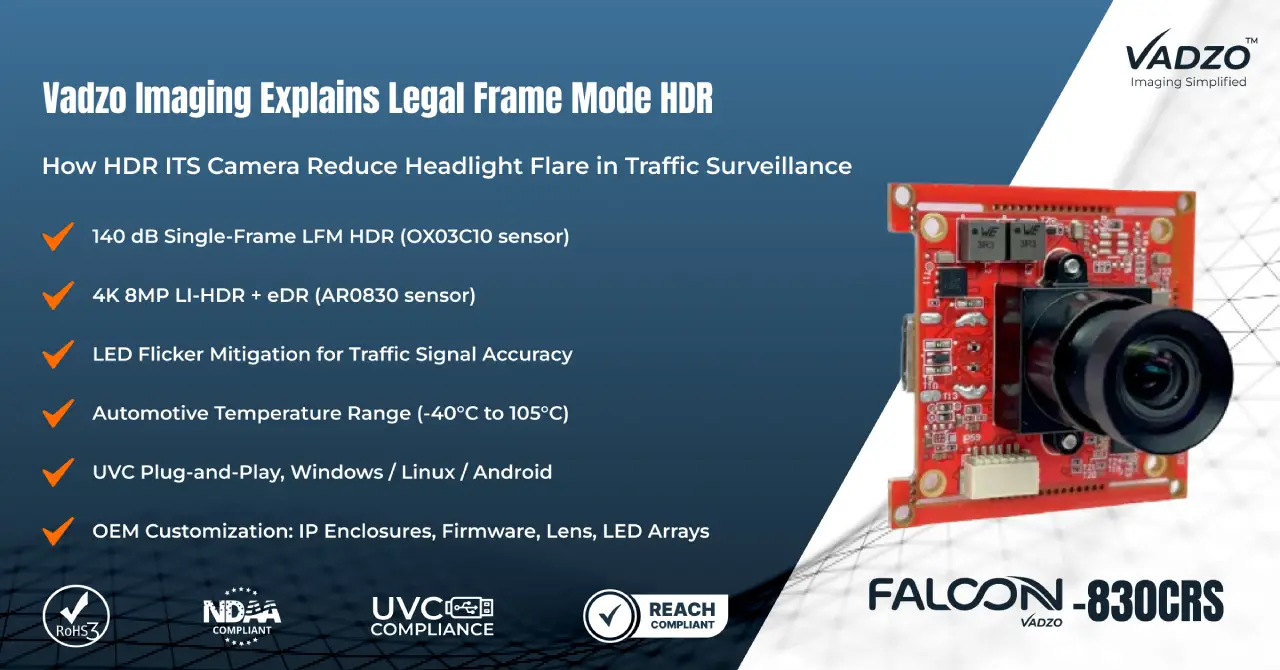
Key specs: AR0830 CMOS Sensor from Onsemi Hyperlux LP | 1/2.9″ | 8MP (3840 x 2160) | 1.4 µm x 1.4 µm Pixel Size | LI-HDR + eDR | USB 3.2 Gen1 Type-C (backward compatible to USB 2.0) | S-Mount (M12 Standard) | -30°C to 70°C Operating Temperature | UVC, RoHS 3 and REACH Compliance
Falcon-3C10CRS: 2.5MP LFM HDR USB Camera with OX03C10 Sensor
For deployments where the primary requirement is LED flicker mitigation rather than 4K resolution, the correct choice in the Vadzo Falcon portfolio is the low-light traffic camera based on the Omnivision OX03C10 sensor.
The OX03C10 is an automotive-grade CMOS image sensor built with Omnivision’s PureCel Plus-S technology. It delivers 140 dB HDR within a single frame period with best-in-class LED flicker mitigation performance. The 140 dB figure represents the dynamic range available in a legally coherent single-frame capture, the correct metric for tolling camera and automated enforcement applications.
The 3.0 µm pixel size is the correct choice for a 1080p HDR Camera in a day-night camera role at roadside ITS nodes. The larger pixel provides the photon collection floor that enables LFM performance to remain stable at low ambient illuminance levels. The automotive-grade -40°C to 105°C operating range qualifies the sensor for year-round outdoor mounting without enclosure-level active thermal management in most deployment latitudes.
The Falcon-3C10CRS is a UVC HDR Camera providing driverless integration with existing ITS edge computing platforms. The same SDK and ARC software suite that supports the Falcon-830CRS governs the Falcon-3C10CRS, reducing integration overhead for OEM developers building multi-sensor ITS platforms with both 4K and LFM HDR imaging nodes.
Key specs: OX03C10 CMOS Sensor from Omnivision (PureCel Plus-S Technology) | 1/2.6″ | 2.5MP (1920 x 1280) | 3.0 µm x 3.0 µm Pixel Size | 140 dB HDR with LED Flicker Mitigation | 1080p@60fps, 720p@60fps and VGA@90fps | USB 3.0 Gen1 Type-C (backward compatible to USB 2.0) | S-Mount (M12 Standard) | -40°C to 105°C Operating Temperature | UVC, RoHS 3 and REACH Compliance
Applications
The Vadzo Falcon camera portfolio addresses the following intelligent transportation system camera application segments:
License plate capture at tolling lanes: The Falcon-830CRS 4K HDR and the Falcon-3C10CRS LFM HDR both address the headlight flare problem that causes ANPR rejection in night tolling operations. The 4K resolution of the AR0830-based unit supports multi-lane gantry deployments with a single sensor. The OX03C10-based unit provides the 140 dB LFM HDR performance required when LED variable message signs or loop-detector-triggered flash illumination are part of the license plate camera integration.
Intersection monitoring: At signalised intersections, a smart city camera must simultaneously resolve vehicle detail across lanes lit to different levels and capture the LED traffic signal state reliably. LFM eliminates the duty-cycle dropout failure mode. The Falcon-3C10CRS OX03C10 sensor camera product handles both requirements within a single frame at 1080p@60fps.
Highway surveillance and vehicle classification: The Falcon-830CRS delivers 4K imaging in an 8MP sensor format suitable for multi-lane highway surveillance camera applications where vehicle classification, axle counting, and incident detection require spatial resolution that 1080p sensor products cannot provide.
Fleet management and telematics : The automotive temperature range and USB interface of both Falcon camera products extend naturally to fleet management and telematics deployments where in-vehicle forward-facing imaging must handle the same headlight flare conditions as roadside ITS infrastructure. The LFM capability of the Falcon-3C10CRS and the LI-HDR mode of the Falcon-830CRS address the dynamic range challenge in both roadside and vehicle-mounted configurations.
Frequently Asked Questions (FAQs)
1) What is Legal Frame Mode HDR, and why does it matter for traffic enforcement imaging?
Legal Frame Mode HDR captures both high-gain and low-gain pixel data within a single frame period rather than merging separate exposures taken at different moments. That distinction matters enormously in automated enforcement and tolling. A multi-exposure merged image represents a composite of two different instants in time, which means a moving vehicle can appear distorted or inconsistent across the frame. An LFM capture is a legally coherent single moment, and that is what courts and enforcement authorities require. For any ANPR or tolling deployment where the image is evidence, LFM is not optional.
2) What HDR camera products are best suited for ANPR tolling lanes and night enforcement nodes?
Vadzo’s headlight flare camera , built on the Omnivision OX03C10 sensor, is the right choice where headlight flare and LED signal dropout are the dominant failure modes. It delivers 140 dB HDR in a single frame period with best-in-class LED flicker mitigation, which makes it well-suited to night tolling lanes and high-speed enforcement nodes. For multi-lane deployments that need full 4K coverage, Vadzo’s 4K HDR camera built on the AR0830 sensor offers 8MP resolution at 3840 x 2160 with LI-HDR and eDR modes for wide lane imaging.
3) What specifications should engineers look for in a USB HDR camera product for ITS and roadside applications?
The core specifications to evaluate are dynamic range in dB within a single frame period rather than multi-exposure, pixel size for low light sensitivity, LED flicker mitigation for modern traffic signalling environments, and operating temperature range for outdoor enclosures. The OX03C10-based module from Vadzo covers all of these with 140 dB single-frame HDR, a 3.0 µm pixel, and a -40°C to 105°C operating range. It runs at 1080p at 60fps over USB 3.0 with full UVC compliance for driverless operation on Windows, Linux, and Android, which simplifies platform integration considerably.
4) Does Vadzo offer OEM customization for outdoor roadside ITS deployments?
Vadzo offers full OEM customization across its Falcon camera portfolio. That includes board redesigns and form factor changes, firmware modifications for custom feature sets, NIR and colour LED array board integration, lens holder and filter modifications, and IP-rated enclosure design and manufacturing for pole and gantry mounting. The automotive-grade temperature ranges built into Vadzo’s ITS modules are a solid baseline, and enclosure-level thermal management for more extreme environments is available as part of the service. Volume pricing and design-in support can be requested directly through Vadzo sales .
5) Can HDR camera products integrate with edge AI platforms for smart city vehicle detection and LPR?
Yes. Vadzo’s USB 3.0 ITS modules are UVC compliant, which means they operate without drivers on Windows, Linux, and Android and connect cleanly to edge AI inference boards commonly deployed in smart city solutions for vehicle detection, classification, and licence plate recognition. For teams that need deeper control, Vadzo provides SDK access through its ARC software suite, covering camera control, ROI configuration, Smart GPIO, streaming management, and firmware updates. OEM developers working on a custom industrial HDR camera integration also get direct support from Vadzo’s applications engineering team through design-in and production ramp.
Availability
The Falcon-830CRS 4K HDR USB camera and the Falcon-3C10CRS LFM HDR USB camera are available for OEM evaluation. Evaluation kits ship with SDK, cable, and default lens. No minimum order quantity applies. Volume pricing, firmware customization, optics selection, and enclosure design services are available on request. For inquiries, contact the Vadzo sales team at support@vadzoimaging.com or visit www.vadzoimaging.com .
Explore the Falcon-830CRS: AR0830 4K HDR HyperLux USB Camera
Explore the Falcon-3C10CRS: OX03C10 2.5MP LFM HDR USB Camera
About Vadzo Imaging
Vadzo Imaging develops high-performance embedded and machine vision imaging solutions for OEMs and system integrators building next-generation intelligent systems. The company delivers imaging platforms across USB, MIPI, GigE, Wi-Fi, and SerDes interfaces, supporting applications in industrial automation, robotics, smart city infrastructure , security and surveillance , telematics and fleet management , and edge AI. Beyond hardware, Vadzo provides end-to-end imaging expertise, including sensor integration, ISP tuning, firmware development, and OEM customization services that accelerate development and deployment at scale.
Media Contact
Alwin Vincent
Vadzo Imaging
Email: alwin@vadzoimaging.com
LinkedIn: Vadzo Imaging
YouTube: Vadzo Imaging
X: Vadzo Imaging
SOURCE: Vadzo Imaging
View the original press release on ACCESS Newswire