
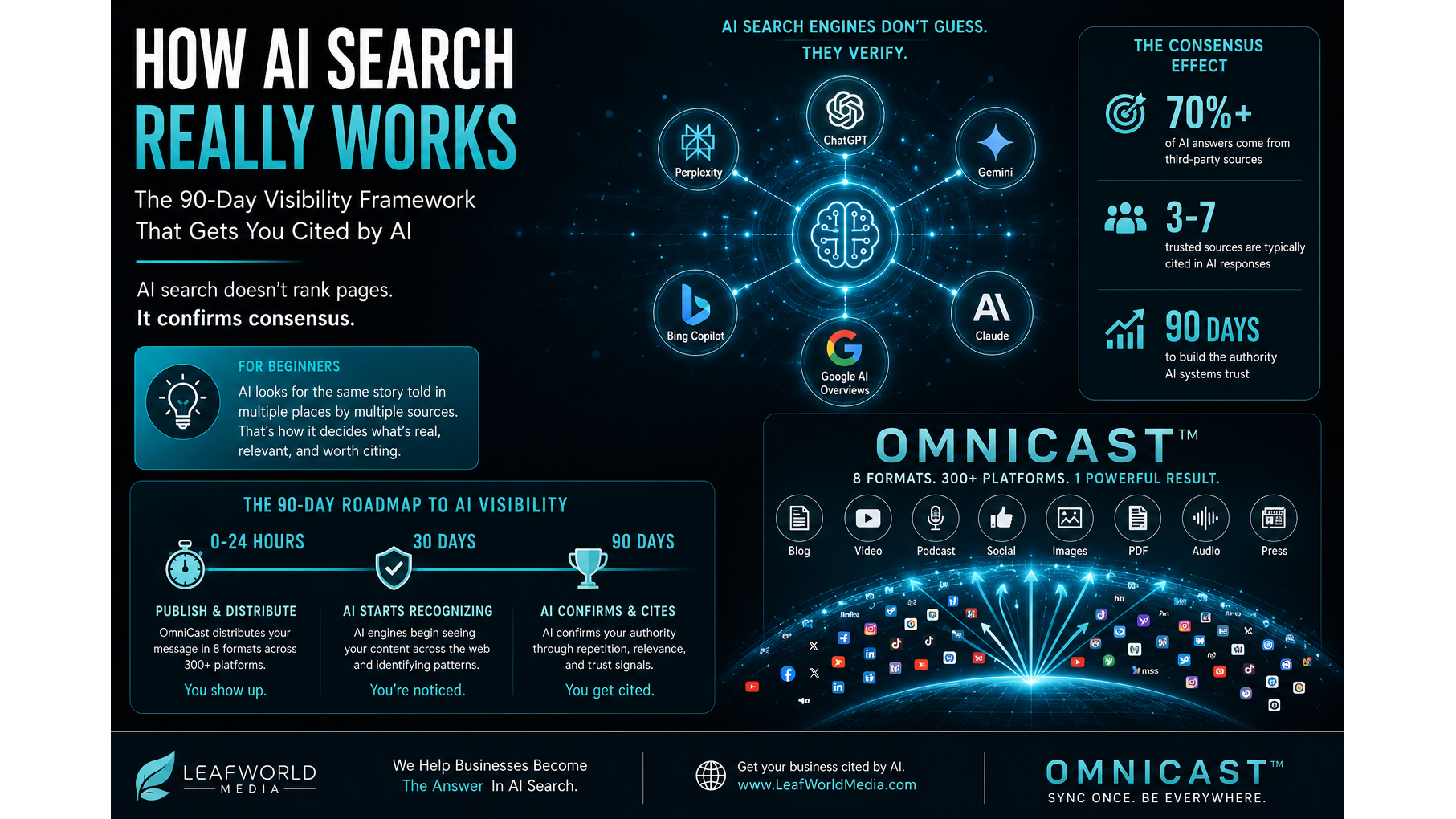
Key Takeaways
- AI engines like ChatGPT and Perplexity do not rank websites in the traditional SEO sense – they evaluate and cite specific content passages from sources they have verified as authoritative across multiple platforms.
- Three signals determine whether a business gets cited: consistency of information, breadth of platform presence, and the credibility of the sources carrying that information.
- Structured data – specifically FAQ schema and Speakable schema – acts as a direct technical signal that helps AI engines identify and prioritize your content.
- Leaf World Media’s OmniCast protocol automates the hardest parts of this process, distributing content across 300+ platforms in 24-48 hours.
- The window to claim AI citation authority in most local and niche markets is still open in 2026 – but competition is accelerating fast.
AI Engines Now Answer Before Google Ranks
Something fundamental has shifted in how people find businesses. More and more, the first answer someone gets to a question like “Who’s the best HVAC company near me?” or “What’s the top accounting firm for small businesses?” is a direct, confident response from ChatGPT, Perplexity, or Google AI Overviews. The search result comes second, if it comes at all.
For businesses, this creates a new visibility layer that most haven’t started to think about. Traditional SEO builds rankings. Answer Engine Optimization (AEO) builds citations – the mentions inside AI-generated answers that reach buyers who never scroll a search results page. That distinction matters more every month.
A detailed breakdown of exactly how this works – and what businesses need to do about it – is covered in this guide from Leaf World Media, which outlines the citation mechanics behind today’s leading AI platforms and what’s required to appear in them.
Why Most Businesses Get Skipped
Most small and mid-sized businesses have a website, a Google Business Profile, and maybe a social media page. That feels like a solid presence – but to an AI engine, it barely registers. The businesses getting cited consistently are not necessarily bigger or better. They are simply more present, across more places, in more formats.
AI Engines Synthesize From Many Sources – Not Just Your Website
ChatGPT and Perplexity do not crawl a single website and form an opinion. They synthesize information from massive datasets pulled from news articles, Wikipedia, podcasts, directories, YouTube, social platforms, Reddit, and thousands of other indexed sources. A business that only exists in one or two of those places is invisible to the pattern-recognition process these engines use to verify authority.
The brands that get cited have content appearing across many independent, trusted sources – all saying consistent things. That cross-source consensus is what tips an AI engine from “maybe” to “cite.”
How ChatGPT and Perplexity Select Sources Differently
These two platforms do not use the same logic. ChatGPT tends to favor Wikipedia-style editorial authority and well-established institutional sources. Perplexity, being a real-time retrieval engine, skews toward recent content and community-validated sources like Reddit. That distinction matters because a strategy built only for one platform may underperform on the other. Getting cited across both requires breadth – not just depth on a single channel.
Authority Signal 1: Consistency
Consistency is the baseline. If a business’s name, address, phone number, founding date, or service descriptions vary across platforms – even slightly – AI engines flag the inconsistency as a reliability problem and reduce citation confidence. It’s the digital equivalent of a witness whose story keeps changing.
Why Inconsistent Entity Data Gets You Omitted
AI engines cross-reference what’s called “entity data” – the structured, factual profile of a business as it appears across the web. When Organization schema on a website says one thing, but LinkedIn says another and Crunchbase says a third, the AI cannot confidently attribute any single version to the real entity. The result: the business gets omitted or misrepresented in generated answers. Locking down consistent NAP (name, address, phone) and service descriptions across every profile is a prerequisite for citation, not just good hygiene.
Authority Signal 2: Breadth
Consistency tells AI engines your information is reliable. Breadth tells them you’re established. A business appearing across news sites, podcast platforms, video channels, directories, and social platforms sends a far stronger signal than one living exclusively on its own website.
Cross-Platform Consensus Drives AI Recommendations
Research on AI citation behavior confirms that multi-platform presence is a core factor in AI visibility. Studies show that content ranking first in traditional search carries only a 33% citation rate in AI-generated answers – a clear sign that AI citation follows different rules than search rankings. Brands with synchronized content across five or more independent, trusted domains consistently outperform single-channel competitors in AI citation rates. That’s not about gaming an algorithm – it’s about matching how AI engines actually verify authority. They look for consensus across independent sources, and the more trusted sources that corroborate a brand’s expertise, the more confidently the AI recommends it.
AI-Referred Traffic Converts at Higher Rates
There’s a practical upside beyond visibility. Research from BrightEdge indicates that visitors arriving from AI-cited links convert at significantly higher rates than standard organic visitors – because the buyer has already been pre-qualified by the AI’s answer. They arrived because the AI named the business as the authoritative source. That’s a different kind of lead than someone clicking a ranked result out of curiosity.
Authority Signal 3: Source Credibility
Not all platforms carry equal weight. A citation from a low-traffic blog and a citation from a FOX affiliate news site both count as “a source” – but AI engines treat them very differently. Brand recognition and institutional credibility show a stronger correlation with AI citations than backlinks alone, which is a meaningful departure from how traditional SEO has historically rewarded authority.
Platforms That Build Cross-Web Consensus
The platforms carrying the most weight in AI citation logic include major news syndication networks, Google News-indexed outlets, established podcast directories like Spotify and Apple Podcasts, YouTube, LinkedIn, Wikipedia, community platforms like Reddit, and high-authority industry directories. Appearing across a combination of these – with consistent, well-structured content – creates the kind of cross-web consensus AI engines treat as a verification signal. One press release on a wire service doesn’t build it. A synchronized presence across dozens of credible platforms does.
The Technical Layer AI Engines Expect
Beyond content and platform presence, there’s a technical layer that directly signals AI engines. Two schema types matter most right now.
FAQ Schema and Structural Clarity
FAQ schema is structured data embedded in a webpage’s HTML that explicitly tells crawlers: here is a question, and here is the answer. Pages with FAQ schema are 3.2 times more likely to appear in Google AI Overviews compared to pages without it – even when controlling for content quality and ranking position. Every service page or topic page on a business’s website should have it. It’s the single highest-impact technical change available without a full site rebuild.
Speakable Schema for Voice and AI Assistants
Speakable schema marks specific sections of a webpage as the most authoritative content for text-to-speech synthesis – essentially flagging to AI assistants: read this part when someone asks about this topic. Google recommends keeping speakable-marked content concise, around 20-30 seconds of spoken audio, or roughly two to three sentences. Adding it to a homepage and key service pages is a direct signal to AI engines about what content to prioritize when formulating answers about a brand.
OmniCast: Automating the Hardest Parts
Understanding these three authority signals is straightforward. Executing them manually – pitching news outlets, producing eight content formats, distributing across hundreds of platforms – is where most businesses stall. The logistics alone require resources most small businesses don’t have sitting idle.
Leaf World Media’s OmniCast protocol was built specifically for this gap. One topic brief gets transformed into eight professional content formats: an authority news article distributed to FOX affiliate sites and Google News, an expert blog post, an interview-style podcast on Spotify and Apple Podcasts, a long-form YouTube video, short-form video reels, an infographic, a digital flipbook, and social media posts – all distributed across 300+ platforms within 24-48 hours. That’s the multi-format, multi-platform presence AI engines use to verify a brand as the authoritative answer in its category, delivered without requiring a business owner to manage any of it.
AI platforms also exhibit a measurable recency bias – content updated within the past 30 days can earn significantly more citations than older content, particularly for real-time retrieval engines like Perplexity. OmniCast campaigns run on a repeatable cycle, which means that compounding freshness signal builds with each subsequent campaign, not just the first one.
The Window to Claim AI Citation Authority Is Open – But Closing
In most local and niche markets, AI citation authority is still unclaimed. A regional law firm, a local contractor, a specialty retailer – these businesses can still become the default AI-cited answer in their category if they act before competitors do. Once an AI engine establishes a citation pattern around a brand, displacing it becomes significantly harder.
The businesses that will dominate AI-generated answers in 2026 and beyond are the ones building synchronized, multi-platform authority now – not the ones waiting to see how the landscape settles. Every month without it is a month a competitor is widening the gap.
The mechanics are clear. The window is open. The question is whether to move first or catch up later.
Leaf World Media specializes in Answer Engine Optimization and the OmniCast content distribution protocol – visit their website to learn how they help businesses build the multi-platform authority AI engines use to decide who to cite.
Leaf World Media LLC
jerry@LeafWorldMedia.com
+1-718-640-2855
Woehrle ave
Staten Island
New York
10312
United States


