QINGDAO, SHANDONG, CHINA, November 3, 2026 /EINPresswire.com/ — Sample-preparation workflows for mineral analysis are commonly broken down into well-known unit-operations: crushing, splitting, pulverising and final assay aliquoting. In modern global mineral laboratories operating under ISO/IEC 17025 requirements and sustainable-mining frameworks, homogenisation quality directly shapes the reliability of fire-assay, XRF and geochemical datasets.
Dry mineral powders exhibit intrinsic physical tendencies toward segregation. Density differences, variable grain sizes and particle cohesion drive spontaneous separation, even after thorough grinding. Many laboratories select mixing equipment based purely on advertised throughput, without examining how mechanical design interacts with mineral-powder physical properties. This article explores how vessel geometry translates into real-world blending performance for mineral matrices, contrasts expected results against practical field observations, and clarifies where asymmetric V-type mixers deliver value — and where they cannot overcome material-driven limitations.
How V-Type Mixer Geometry Creates Blending Action
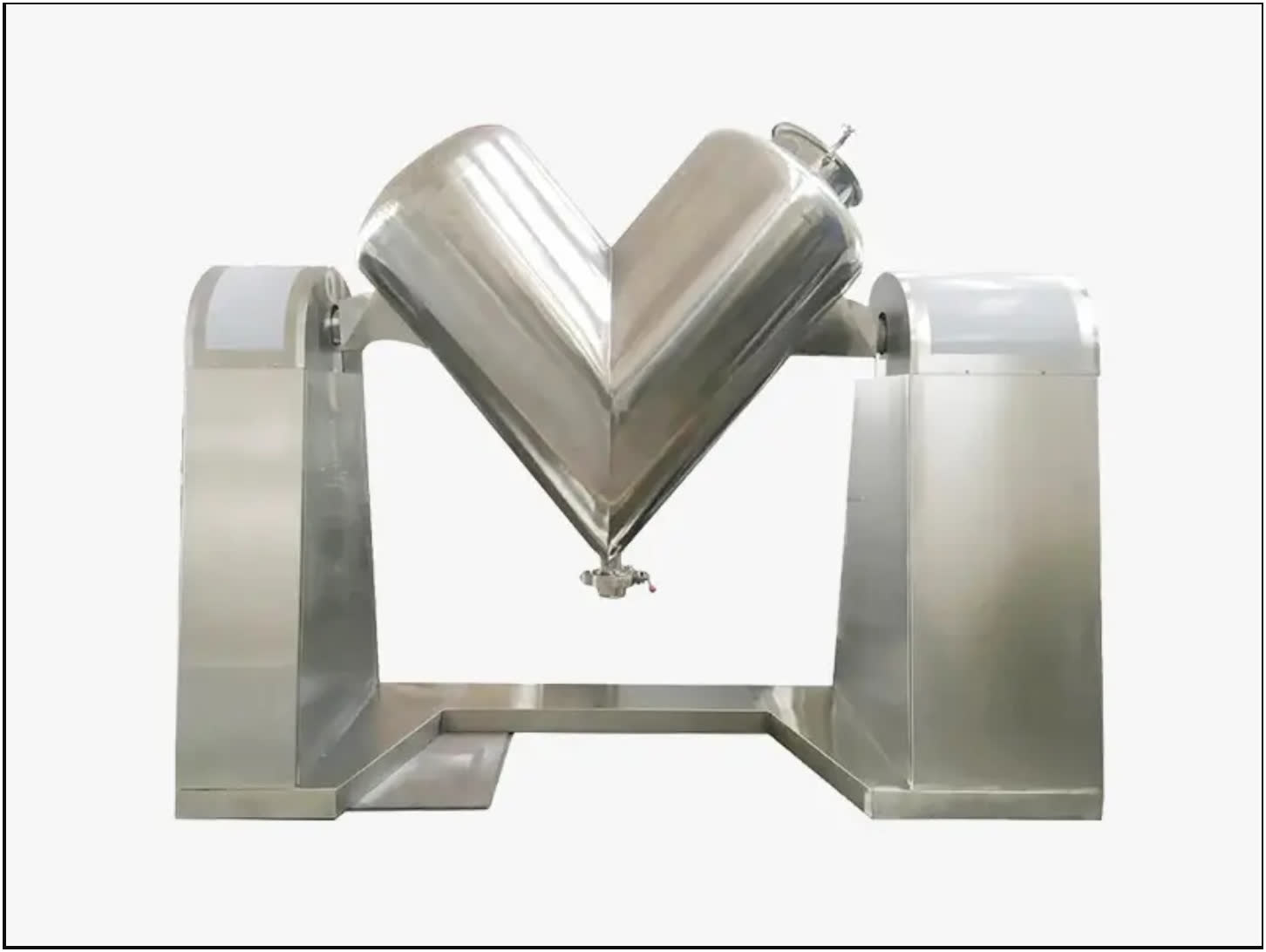
Unlike high-shear blenders fitted with agitator shafts, V-type mixers generate mixing purely from vessel rotation and gravitational particle movement. The asymmetric V-shaped chamber consists of two cylindrical arms of unequal length, rotating within a fixed two-dimensional rotational plane.
As the assembly turns, powder mass climbs along the inner wall until gravity overcomes static friction. Material cascades downwards and converges at the central V-junction. Continued rotation then divides the bulk powder stream, sending fractions into each of the two unequal arms. Each full rotation completes a repeating cycle of convergence and divergence.
The asymmetry of arm lengths forms the core functional difference compared to symmetric tumble blenders. Particles spend different residence times inside each arm, fall from differing heights and generate transverse convective motion plus mild inter-particle shear. This continuous re-distribution reduces density-based segregation through diffusion-dominated mixing.
A critical physical consequence of this working principle is low mechanical attrition. Since there are no internal impellers, particle-to-particle tumbling dominates. Pre-existing particle-size distributions from prior pulverising steps remain largely intact. For mineral testing this is a meaningful advantage: unwanted secondary comminution would alter grain-size characteristics and introduce additional analytical uncertainty.
Performance Realities Across Three Typical Mineral-Laboratory Use-Cases
Equipment capability can only be judged against real-world sample matrices. Below are practical performance observations gathered from geochemical, mine-QC and commercial-contract-testing environments.
1. Geological survey laboratories: large-batch dry rock and drill-core powders
For free-flowing, low-cohesion rock pulverised samples, asymmetric V-type mixing produces consistent homogenisation. Batch-to-batch repeatability enables technicians to lock rotation speed and cycle duration into formal SOP documents. Full-vessel tipping discharge reduces residual powder hold-up, an important benefit when processing large geochemical survey batches.
Where projects contain clay-bearing or partially-moist specimens, performance degrades sharply. Powder adheres to inner surfaces, breaks the cascade-convergence cycle and leaves significant fractions unmixed. In these instances pre-drying becomes an absolute pre-requisite before charging material into the mixer.
2. Mine-site quality-control: flotation concentrates and tailings powders
Flotation concentrates that remain dry and free-flowing respond well to V-type tumble blending. Laboratories can achieve homogeneous feed material for XRF and wet-chemistry aliquots.
However, tailings samples frequently bring compounding challenges. If feed material combines very heavy metallic mineral grains alongside light silicate gangue, extreme density contrast cannot be fully resolved by gravity-driven diffusion alone. Heavy particles still settle preferentially during rotation, leaving residual segregation. In such cases even extended mixing cycles will not deliver acceptable homogeneity, and alternative mixing technologies must be considered.
3. Third-party contract-testing facilities: multi-matrix high-turnaround workflows
Contract labs process constantly changing ore types, which places high demands on equipment cleanability. The impeller-free polished interior of V-type vessels minimises hidden powder-trapping recesses. When operators follow standard brushing and purging protocols, cross-contamination risk between dissimilar ore matrices stays low.
This strength disappears when handling hard, strongly agglomerated fine powders. Diffusion-based tumbling provides minimal de-agglomeration shear. Compacted particle clusters remain intact, and agglomerates themselves become sources of subsampling bias. These samples require separate pre-de-agglomeration steps before homogenisation.
System-Level Operational Factors Beyond Mixing Kinematics
Vessel geometry determines blending physics, yet auxiliary hardware dictates long-term service life and sample integrity in continuous-operation mineral labs. Two design points are frequently overlooked during equipment evaluation.
First is rotary-shaft sealing. Simple packing-gland seals suffer powder ingress under mineral-lab dust-rich conditions, leading to material loss, cross-batch contamination and premature mechanical wear. Modern mineral-focused units adopt mechanical shaft seals, which substantially reduce fugitive fine-powder leakage during repeated tumble cycles.
Second is surface finish. Polished stainless-steel contact surfaces lower powder adhesion and offer resistance against weak mineral-acid-base corrosion. Rough cast surfaces retain fine mineral dust, increase cleaning labour and raise carry-over risk across sample batches.
These auxiliary components do not improve intrinsic mixing kinetics, yet they define whether theoretical mixing performance can be sustained over months and years of daily laboratory operation.
Distinguishing Inherent Physical Limits From Equipment Defects
A common source of laboratory frustration arises when users expect universal performance from gravity-driven tumble mixers. Limitations stem from fundamental powder physics rather than manufacturing faults:
Moist, cohesive, clay-rich samples break the cascade-and-converge mixing cycle. Pre-treatment (drying) is mandatory.
Samples with extreme density or particle-size disparity retain segregation despite prolonged mixing cycles. Gravity diffusion has physical boundaries.
Hard particle agglomerates cannot be broken apart by low-shear tumbling; mechanical de-agglomeration must happen upstream.
When sample properties fall outside these operating boundaries, investing in longer mixing time will not resolve bias. Laboratories must either adjust sample pre-processing workflows or select alternative mixing principles with forced agitation.
The V-type mixer engineered by Qingdao Decent Group implements asymmetric two-dimensional tumble-vessel geometry, mechanical shaft-sealing and polished stainless-steel wetted parts. Models such as DVM300 are built for medium-batch dry-powder mineral-sample homogenisation and are integrated within complete sample-preparation lines across global mineral-analysis laboratories.
Full technical specification: https://www.decent-group.com/product/v-type-mixer/
Within global sustainable-mineral-resource governance, homogenisation represents a critical, under-discussed link in the analytical value chain. Asymmetric V-type mixers deliver cost-effective, low-shear gravity-driven blending for free-flowing dry mineral powders. Their performance is not universal: mixing outcomes are governed by the interplay between vessel geometry and the physical properties of the mineral powder itself.
Successful sample-preparation strategy requires laboratories to match mixing-principle capability against actual sample-matrix characteristics, rather than treating any single mixer design as a one-size-fits-all solution. Recognising these physical boundaries helps laboratories minimise segregation-originated bias and preserve the credibility of mineral-assay results used for resource evaluation and commodity trade.
DECENT
DECENT
Legal Disclaimer:
EIN Presswire provides this news content “as is” without warranty of any kind. We do not accept any responsibility or liability
for the accuracy, content, images, videos, licenses, completeness, legality, or reliability of the information contained in this
article. If you have any complaints or copyright issues related to this article, kindly contact the author above.

Media gallery